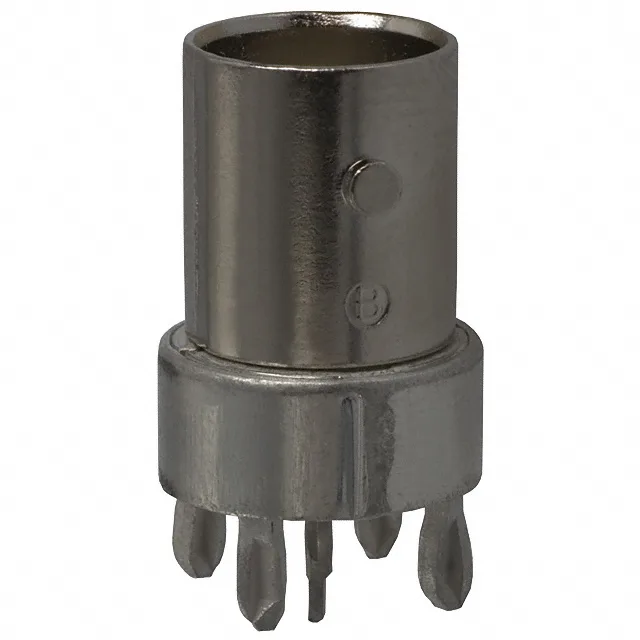
This is the 75 Ohm variant of the standard BNC interface, not the more common 50 Ohm version, which means it is impedance-matched for video, broadcast, and telecommunications signal paths where 75 Ohm coaxial cable (RG-59, RG-6) is standard. Rated to 2 GHz with a 500 V voltage rating, it handles the full bandwidth of composite video, HD-SDI, and baseband digital video distribution without the impedance mismatch a 50 Ohm connector would introduce.
Signal Path and Frequency Range
The 75 Ohm characteristic impedance is the defining parameter for this connector — it matches the nominal impedance of broadcast video and CCTV coaxial cable, so the signal sees no reflection at the interface. The 2 GHz maximum frequency covers standard-definition and HD video rates with margin; beyond 2 GHz the insertion loss and return loss degrade as the BNC interface geometry reaches its electrical limit.
Termination and Board Attachment
Both the shield and the center contact terminate via press-fit — no solder required. This solderless attachment is common in backplane and high-reliability assemblies where rework access is limited or where thermal stress from wave soldering could shift the impedance of the launch. The through-hole mounting gives better mechanical retention than an SMT BNC, especially under repeated cable strain from the bayonet lock.
Mating Cycles and Contact Durability
The gold-over-beryllium-copper center contact maintains low and stable contact resistance through repeated connect/disconnect — the beryllium copper spring properties resist relaxation over the life of the connector.
The PTFE dielectric is the standard choice for 75 Ohm BNCs — its low dielectric loss at frequency and stable permittivity across temperature keep the impedance within tolerance. The bayonet lock (BNC standard) gives a quarter-turn mating that is faster than a threaded interface and provides positive retention against accidental disconnection from cable tug.