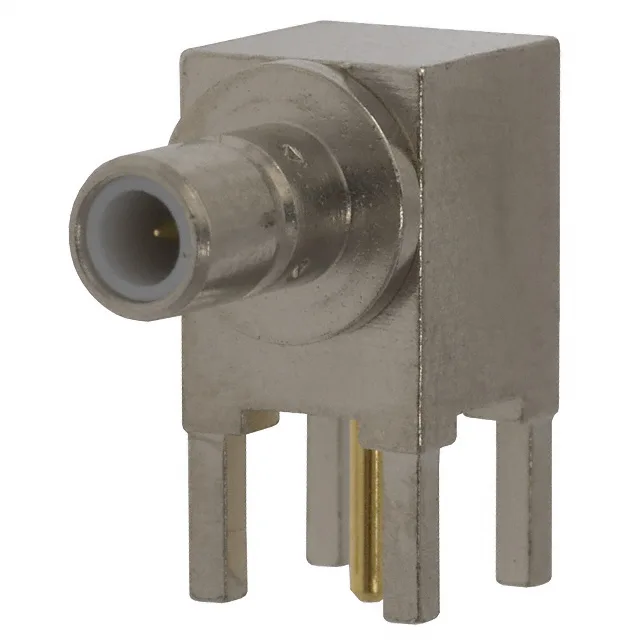
SMB Jack, 50 Ohm, 3 GHz — Right-Angle Through-Hole
The 414337-1: The snap-on fastening allows quick connect-disconnect cycles — rated for 500 matings — without the thread engagement of an SMA, which trades some vibration resistance for faster field service. A single-port design, bulk packaged.
50 Ohm is the industry-standard impedance for RF systems — matching the characteristic impedance of common coaxial cables like RG-58, LMR-195, and most test equipment ports. The 414337-1 holds that impedance through the right-angle launch, so the signal sees a controlled transition from the board trace to the cable. The 0.6 dB insertion loss at 3 GHz is typical for an SMB jack at this frequency; it means about 87% of the input power reaches the far end through one mated pair. With a 335 V voltage rating, the dielectric (PTFE) can handle moderate-power RF signals without breakdown — think base station IF stages, instrumentation, or low-power transmitters. The limiting factor at 3 GHz is the connector geometry, not the voltage standoff.
Snap-On vs Threaded — Mating Cycle Reality
The snap-on coupling is the defining difference between SMB and SMA. It mates with a push-and-click action, no torque wrench, no thread wear. The 500-cycle rating is the manufacturer's specified life — after that, the retention spring may lose its grip, and the contact resistance can drift. For bench test cables or internal board-to-board RF jumpers that get disconnected a few times a year, 500 cycles is plenty. For a production test fixture that cycles daily, you'd want a threaded interface. Tin plating would gall and oxidise faster under repeated mating — gold is the right call here.