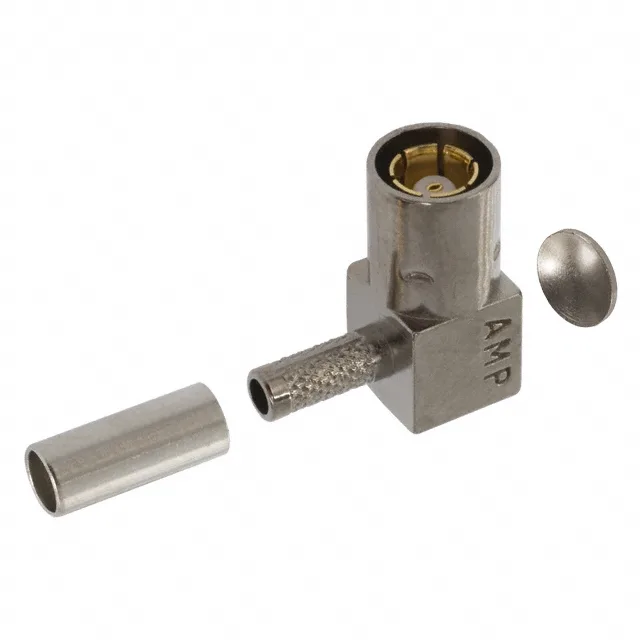
It comes as a three-piece assembly — the connector body, an end cap, and a crimp ferrule — so the kit covers the full cable termination in one BOM line. The right-angle body keeps the cable routed parallel to the board or panel face, which matters when the enclosure height is tight. The 3 GHz ceiling covers ISM bands and GPS L-band. Insertion loss runs 0.6 dB across the band. Cable compatibility is limited to RG-174, RG-188, and RG-316 — the three common 50 Ohm small-diameter coax types. The crimp ferrule and centre solder termination match the braid and centre conductor dimensions of those cables.
The body is zinc with a nickel finish — nickel gives good corrosion resistance for indoor equipment racks and test bench environments, though it is not rated for salt-spray exposure. Gold on the mating interface prevents oxidation build-up that would raise the contact resistance in a low-level RF path. That temperature span covers automotive under-hood and outdoor telecom cabinet environments, though the nickel body limits the corrosion resistance in coastal or chemical-exposure settings.
Mating is snap-on — push until the detent clicks. The snap-on coupling is faster than a threaded SMA and adequate for applications where vibration is moderate and the cable is strain-relieved separately. The right-angle body means the cable exits 90° from the mating axis, which is the typical orientation for board-edge or panel-mount SMB jacks. Termination is a two-step process: solder the centre conductor to the contact pin, then crimp the ferrule over the cable braid. The shield termination is crimp, not solder, which gives a more consistent impedance transition at the cable-to-connector interface. The kit includes the ferrule, so there is no separate ferrule order.