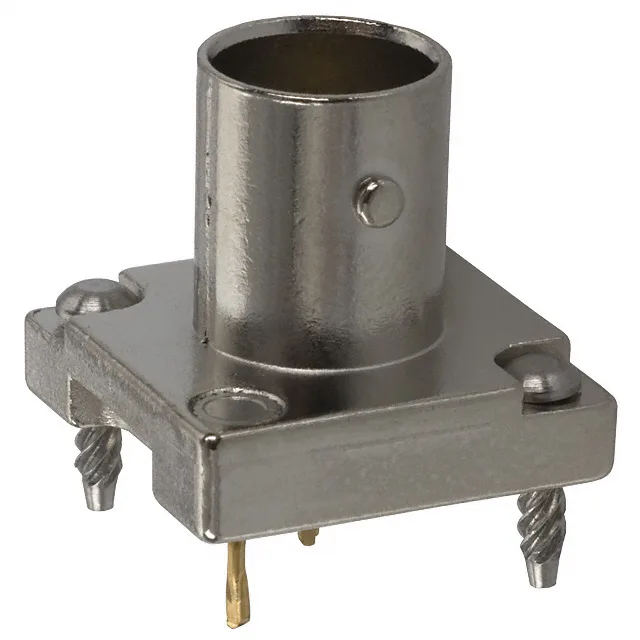
The 75 Ohm impedance — not the more common 50 Ohm — tells you this is a video or broadband interconnect, not a general-purpose RF test port. The press-fit shield and contact termination means no solder wicking into the dielectric — the PTFE insulator stays clean, and the impedance holds through the launch. This matters for automated assembly lines and high-reliability backplanes where a rework-free press-fit joint is preferred over a hand-soldered one. Rated to 2 GHz, this jack covers 3G-SDI video, CATV head-end gear, and baseband broadband distribution. The 500 V rating is the dielectric withstand between centre contact and shell — well above the signal levels in those applications, but it confirms the PTFE insulator is thick enough for the creepage path.
Cable Compatibility and Construction
This jack is spec'd for the RG-122 cable group. RG-122 is a 75 Ohm coax with a solid or stranded centre conductor and a foam or solid polyethylene dielectric — common in video patch panels and closed-circuit TV distribution. If you are using RG-59, the physical dimensions (centre pin diameter and dielectric OD) are close but not identical; the press-fit contact is sized for the RG-122 centre pin, so verify the cable's centre conductor diameter against the jack's contact before committing. The body is zinc with a nickel finish — nickel provides good corrosion resistance for indoor equipment racks and patch bays, though it is not rated for outdoor salt-fog exposure. Gold-over-beryllium copper gives the contact spring a long fatigue life and low contact resistance over those cycles — a solid choice for a patch panel that sees regular re-patching. The PTFE dielectric maintains its dielectric constant across that range, so the impedance shift is minimal.