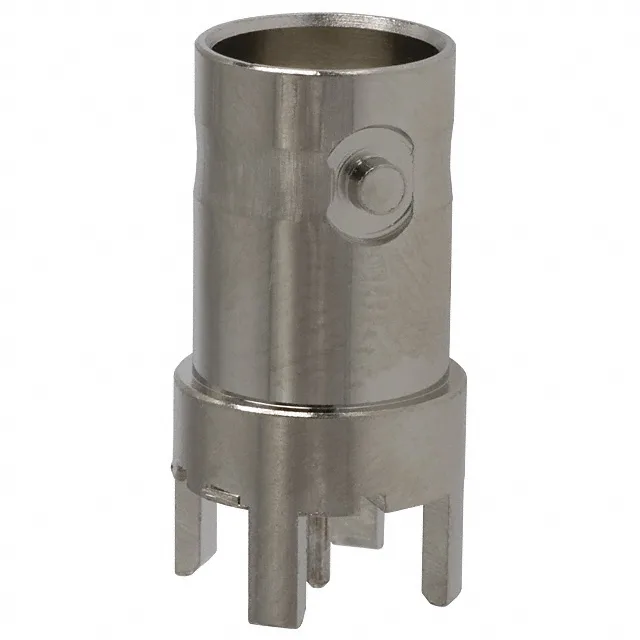
The through-hole solder termination means the centre contact and shield legs go into plated holes on the PCB, giving a mechanically solid joint that holds up to repeated cable strain. Silver plating on the centre contact and nickel on the brass body keep signal loss low across the 4 GHz bandwidth.
Rated for 500 mating cycles, which is the standard endurance for a bayonet-lock BNC — the coupling nut and detent wear before the centre contact does. The 500 V rating is the dielectric withstand between centre and shield; in practice, this connector lives on 50 Ohm lines carrying a few volts of RF or video signal, so the voltage headroom is generous.
Termination and Mounting
Both the centre contact and the shield are solder-terminated — no crimp tool needed, just a soldering iron and the right hole pattern on the board. The shield termination is soldered to the PCB ground plane through the four legs, which also provide the mechanical retention. The dielectric material is polyester, which holds the centre contact concentric to the outer conductor to maintain the 50 Ohm impedance through the joint.
No official cross-reference or second-source is listed on record, so the BOM line should stick with this TE part number unless a direct replacement is verified.