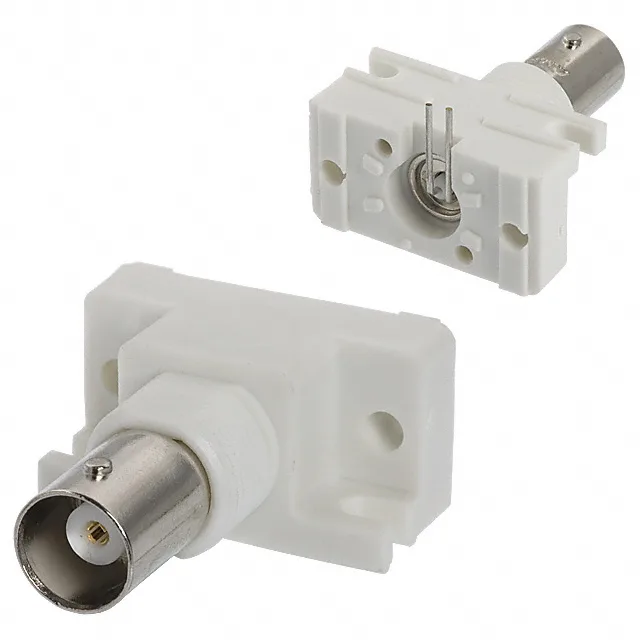
50 Ohm BNC Jack for Panel-Mount RF Interconnects
The 5226978-1: This is the standard impedance for most RF test equipment, telecommunications, and broadcast video applications — a 75 Ohm BNC would be a different part entirely, so the 50 Ohm spec is the first compatibility check. The bayonet lock provides quick connect/disconnect with positive retention — the standard BNC mating interface that engages with a quarter-turn. The nickel-plated zinc body gives adequate RF shielding and corrosion resistance for indoor and sheltered outdoor use. Tin plating is a cost-effective choice for moderate-duty applications — it handles the 500-cycle rating but is not intended for the high-cycle or corrosive-environment duty that gold plating would serve.
This BNC jack uses a panel mount with a flange, secured through the panel cutout, and the signal and ground connections are made via through-hole solder tails on the PCB. The 'Isolated' feature indicates the connector body is electrically isolated from the mounting panel. This avoids ground loops or controls the shield path through the PCB.
Comparison with Peers: 415420-1 and 1057230-1
The 5226978-1 shares the same BNC jack form factor and 50 Ohm impedance with the 415420-1, both in bulk packaging and active lifecycle status. The 415420-1 is a direct cross-shop candidate — same series, same basic specs — and the choice between them comes down to availability and pricing at quote time. The 1057230-1 is a higher-spec peer: it uses a gold-plated body and center contact (beryllium copper), a tetrafluoroethylene (TFE) dielectric, and is rated to 22 GHz. The gold plating on the 1057230-1 supports more mating cycles and better corrosion resistance, while the higher frequency rating suits microwave applications. The 5226978-1 with its tin-plated contact and 4 GHz ceiling is the cost-optimized choice for general-purpose RF work up to 4 GHz.