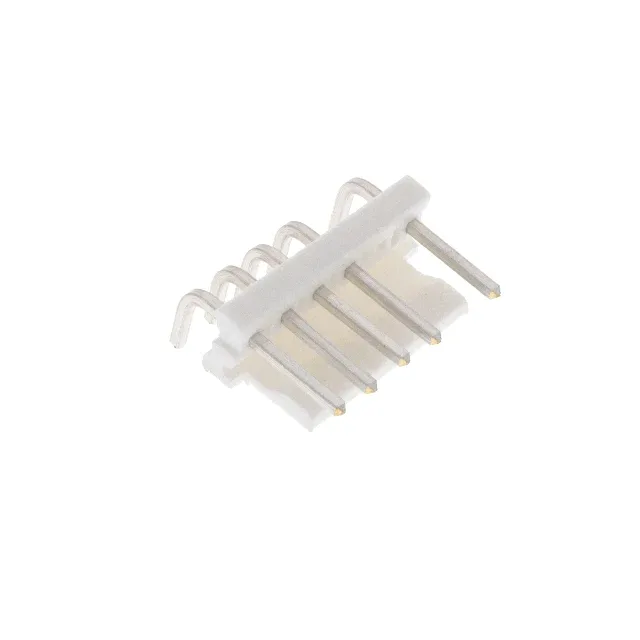
Right-angle header for wire-to-board connections
Its 0.156" (3.96mm) pitch sets the PCB footprint and determines compatibility with the matching MTA-156 receptacle. Six positions are present in the housing, but only five are loaded with pins — one position is empty. This matters for BOM planning: the mating receptacle must account for the missing pin, either by using a 6-position housing with one cavity blocked or by leaving that circuit unwired.
Current rating depends on wire gauge — not a fixed number
For a given wire size, the maximum current is set by the derating curve in the TE application note; expect 5-7 A per contact with 18-20 AWG wire in still air at 25°C ambient. Tin is suitable for moderate mating cycles (50-100 cycles typical) and non-corrosive environments. For higher cycle life or harsh atmospheres, consider the gold-plated variants in the MTA-156 family.
Available through independent distribution channels. Stock and pricing are confirmed at the time of RFQ — no on-hand quantity is held on this listing.
How it compares to similar right-angle headers
Compared to the TE 1-292164-1 (CT series, 0.079" pitch, 11 positions, detent lock), the 644408-1 has a wider 3.96mm pitch — better for higher current per circuit and easier hand-soldering, but takes more board space. The CT series uses a 2.00mm pitch, suited for denser layouts at lower current. Against the TE 953440-3 (0.100" pitch, 6 positions, dual row, friction lock), the 644408-1 is single-row and right-angle, while the 953440-3 is dual-row and also right-angle. The 644408-1's single row simplifies routing for low pin-count connections; the dual-row option packs more circuits in the same board edge length. The TE 1-1871673-2 (0.098" pitch, 4 positions, dual row, detent lock) is a denser alternative for 4-circuit needs, but the 644408-1 offers 5 loaded positions in a single row — better for applications where the board edge has room for a wider connector.