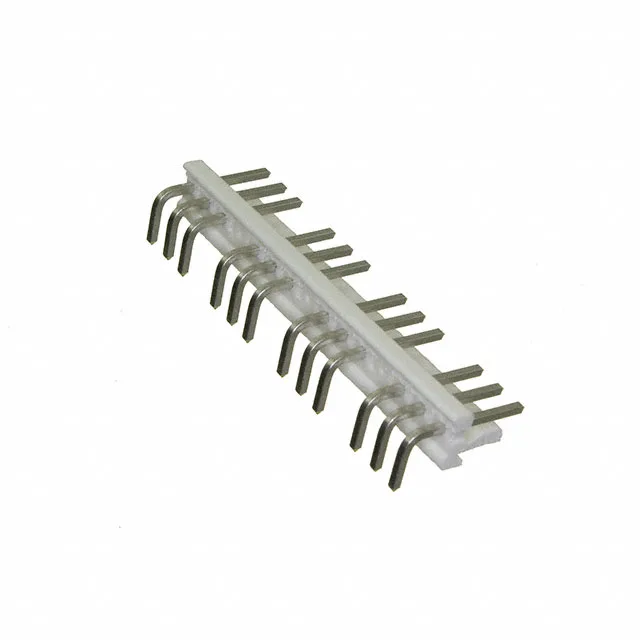
Pitch and position count – what the 15/12 split means for your BOM
The 644958-1: At 0.156" (3.96 mm) pitch, this MTA-156 header mates with the standard MTA-156 receptacle family – the same pitch TE has used for decades in appliance and industrial wire-to-board interconnects. The housing carries 15 pin positions but only 12 are loaded with contacts. That leaves three empty cavities – a deliberate pin-out skip for keying or future circuit expansion. Confirm your wire harness uses exactly those 12 loaded positions before committing the BOM.
Right-angle orientation and board-edge routing
The 0.300" (7.62 mm) insulation height clears most through-hole components on the opposite side.
Friction lock vs. secondary retention
If your application sees continuous shock or cable tug, consider a header with a positive latch or TPA.
Voltage and current – reading the fine print
Rated 600 VAC – that covers 480 VAC motor circuits, panel distribution, and most industrial AC supplies with headroom. For a 20 AWG wire in the MTA-156 system, expect around 5 A per contact at a 30 °C rise.
How this compares to the 1-292164-1 alternative
The 1-292164-1 is a CT series header at 0.079" (2.00 mm) pitch, 11 positions all loaded, with a shrouded 4-wall housing and detent lock – a denser, fully populated alternative for lower-voltage (125 VAC) signal duty. The 644958-1 carries higher voltage (600 VAC) and a wider pitch for heavier wire, but leaves three cavities empty.