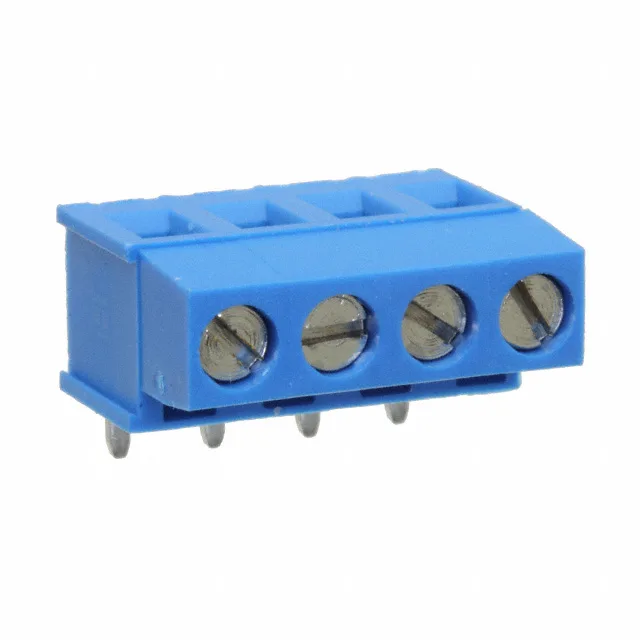
It terminates solid or stranded wire from 12-30 AWG using a screw-driven rising cage clamp — the clamp lifts to trap the conductor against the current bar, giving a gas-tight connection that resists thermal cycling. The blue polyamide (PA66) housing carries a 17.5 A per-position rating at 300 V, suited for power distribution and control wiring inside industrial enclosures, HVAC panels, and building automation equipment where a field-wireable, board-mounted termination point is needed.
Wiring and Termination — What the Screw Torque Means
The rising cage clamp is tightened with an M3 screw to a specified torque of 0.79 Nm (7.0 Lb-In). That torque value is the factory-recommended setting — under-tightening leaves the conductor loose under vibration; over-tightening can strip the brass-nickel screw or deform the cage. The clamp material is brass with nickel plating, the same as the screw, so galvanic compatibility is maintained across the current path. The contact material is brass with tin plating, which mates to the stripped conductor end without requiring a ferrule, though a ferrule is recommended for fine-stranded wire in high-vibration installations.
Ganging Multiple Blocks — Side Interlocking
The housing includes an interlocking (side) feature — a dovetail-style key on one side and a matching slot on the other. This allows multiple 796684-4 blocks to be snapped together side-by-side to build a multi-position assembly without extra hardware. The interlock keeps the blocks aligned on the PCB and prevents them from separating during wire insertion or screw tightening. When ganged, the pitch between adjacent positions remains 5.00 mm across the assembly, so the board layout can be extended by repeating the same footprint.