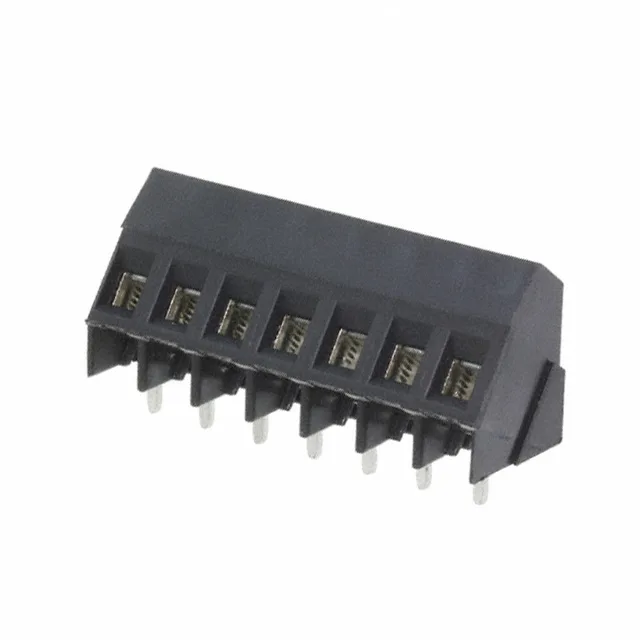
The 796689-7: The 17.5 A per position means this block handles moderate power distribution on the PCB, not just signal-level wiring. The wire entry is angled at 35° (145° relative to the board), which routes conductors away from the board surface at a shallow angle — useful when the enclosure lid or another board sits close above the termination point. Termination is via a rising cage clamp driven by an M3 screw, with a specified torque of 0.79 Nm (7.0 Lb-In). The rising cage pulls the wire up against a tin-plated brass clamp, giving a gas-tight connection that resists thermal cycling better than a simple screw-and-pad. The housing is black polyamide (PA66/Nylon 6/6), UL94 V-0 rated, and the side interlocking feature lets multiple blocks snap together side-by-side to form a multi-position rail without a separate jumper — a practical detail for panel builders who need to scale position counts without ordering a custom part.
Wire Range and Torque — What the Assembly Line Needs
The 796689-7 accepts wire from 12 AWG down to 30 AWG — a wide range that covers both power feeds (12 AWG for the 17.5 A rating) and smaller control wiring. The M3 screw torque of 0.79 Nm is the critical assembly parameter: under-torque risks a loose connection and voltage drop; over-torque can strip the threads in the PA66 housing. A calibrated screwdriver set to 0.79 Nm is the right tool for this block. The contacts and clamp are brass with tin plating — adequate for the rated current in indoor, non-corrosive environments. For outdoor or high-humidity service, the tin plating on the clamp and contacts is a limitation compared to nickel or stainless alternatives.