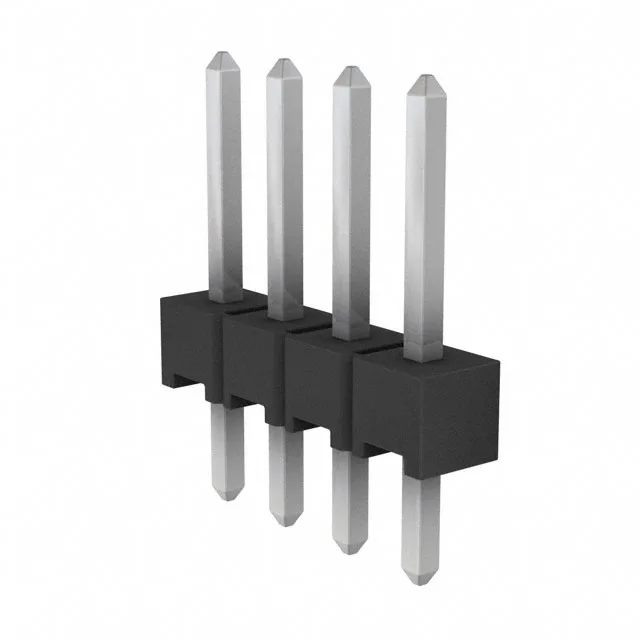
It's listed for board-to-board or cable connections, and the push-pull fastening means there's no latch; in a vibration-heavy environment, you'd want a locking header instead.
Tin is fine for moderate mating cycles—say, a few dozen insertions over the product life—but it frets under vibration and corrodes faster than gold in humid or industrial atmospheres. For a board that gets mated once and stays, it's fine. For field-service reconnects, you'd want a gold-flash variant.
Board Layout Fit: Pitch, Height, and Pin Length
The 0.100" pitch is a standard grid, so the footprint matches common 0.100" receptacles. Overall contact length is 0.533" (13.55mm), with the mating pin extending 0.318" (8.08mm) above the insulator and the solder tail 0.125" (3.18mm) below. The insulator sits 0.090" (2.29mm) off the board—low profile, but the unshrouded pins are exposed, so keep-out zones around the header are minimal.
How This Compares to a Shrouded Alternative
That part is also 4 positions but dual-row, with a 0.098" pitch and 31.5 µinch tin finish. The key difference: the 9-146274-0-04 is unshrouded and single-row, so it mates with a simpler receptacle and takes less board space width-wise, but offers no shell guidance or vibration lock. For a board that sees shock or cable strain, the shrouded alternative is the safer pick.