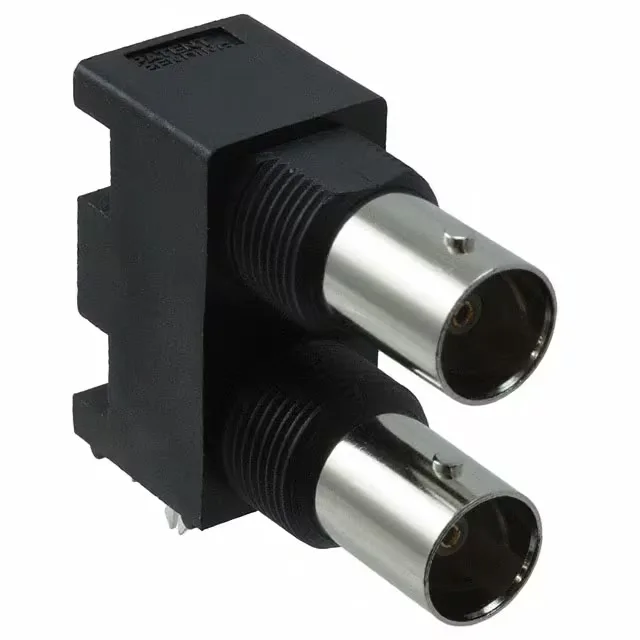
75 Ohm BNC Jack — Dual-Port, Panel-Mount, Right-Angle
The 031-70505: That 75 Ohm impedance is the headline difference from the common 50 Ohm BNC — it is the standard impedance for composite video, broadcast, and precision measurement signal paths where the line impedance is 75 Ohm. The connector is a bulkhead-mount with a front-side nut, so it fixes to the panel and the right-angle PCB tail routes the signal to the board. The housing is black and silver, and the dielectric is polypropylene.
What the 75 Ohm Impedance Means for Your Signal Path
The 75 Ohm impedance sets the characteristic impedance for the whole channel. This jack is the correct choice for 75 Ohm coax cables and equipment designed around 75 Ohm video or data standards. The 1 GHz bandwidth with 0.2 dB insertion loss handles baseband video and SDI without measurable loss.
Dual Ports in One Body — Saves Panel Space
Two BNC jacks in a single shell means one panel cutout instead of two. The ports are isolated from each other — the housing is marked as isolated, so the shell is not tied to ground, which matters for floating-shield or video applications where ground loops are a concern.
The closest functional peer is the 031-5538-10RFX — a single-port BNC jack at 50 Ohm, same 1 GHz bandwidth, same 500-cycle rating, same board lock and isolated housing, same 500 V rating. The decision between them is driven by impedance: 75 Ohm for video/broadcast, 50 Ohm for RF/test. The 031-70505 gives you two ports in one body; the 031-5538-10RFX is a single port in a bulk package. The 31-5640-1010 and 31-5431 are also single-port 50 Ohm parts with similar construction — none is a direct swap for the 75 Ohm dual-port 031-70505.