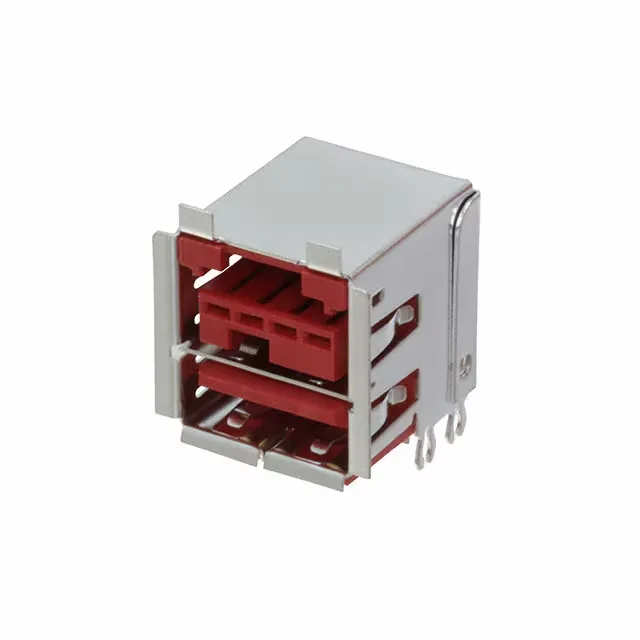
It carries 8 contacts total, with the USB-A contacts handling the data lines and the extra contacts carrying a separate power circuit rated 3 A at 24 V. The connector is part of the 55917 series, designed for applications where a device needs both USB connectivity and a dedicated power feed through one panel opening — common in industrial HMIs, point-of-sale terminals, kiosks, and embedded systems where a separate barrel jack would waste space.
Key Features That Drive Fit
A board lock on each mounting post anchors the connector during soldering and resists the shear force from repeated plug insertions — important for a combo connector that sees both USB and power plug cycles. The fully shielded shell in copper alloy contains USB 2.0 signal EMI and provides a ground return path through the chassis. Gold, GXT™ contact finish on the mating surfaces delivers the corrosion resistance and wear life needed for the rated 1500 mating cycles — well above a typical consumer USB connector, which suggests this part is specified for field-serviceable equipment where the cable gets disconnected regularly.
The 3 A current rating applies per contact, but the power contacts are the load-bearing ones — the USB-A data contacts carry negligible current. At 24 V, the connector covers standard industrial DC rails (24 V nominal) and consumer USB bus power (5 V) with ample margin. The red insulator is a visual key — it distinguishes this variant from the black (55917-600LF) and teal (55917-501LF) versions in the same series, which carry different voltage ratings (12 V) or current ratings (5 A for 55917-001LF).
The 55917-001LF is the closest functional peer — same USB-A + power combo layout, same 8 contacts, same 1500 mating cycles, same board lock and shielding. The key difference is the current rating: 5 A for the -001LF versus 3 A for the -601LF. Both are rated 24 V and use gold GXT™ contacts. The -001LF ships in a tube, while the -601LF comes in bulk. The -601LF is the correct choice when the power draw stays under 3 A per contact and the bulk packaging fits your assembly line better.
The USB 2.0 specification means it is backward-compatible with USB 1.x and 2.0 devices but will not negotiate USB 3.x SuperSpeed rates — the connector physically accepts a USB 3.x plug, but the data rate is limited to 480 Mbps by the 2.0 spec.