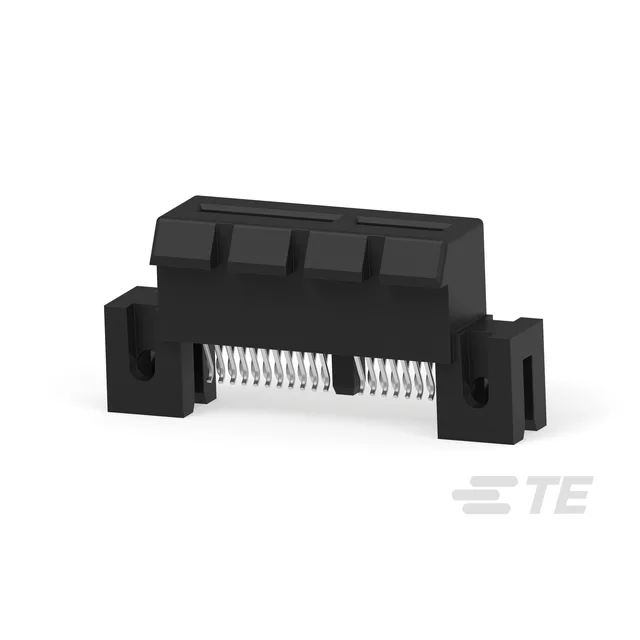
The TE Connectivity 1-2372484-1 is a 36-position PCI Express™ Gen 4 edge card connector built for a 0.062" (1.57mm) card thickness. It uses a 0.039" (1.00mm) pitch dual-row layout, with the positions split 11 and 7 per bay/row — that staggered arrangement matches the PCIe x16 slot keying. The female connector is designed for board-edge, straddle mount installation: the straddle mount opening (unthreaded, 0.087" / 2.20mm) lets the connector sit astride the PCB edge so the card slides in from the opposite side. The card type is PCI Express™, and the connector is rated for Gen 4 signalling speeds.
The 0.039" (1.00mm) pitch is the standard PCIe slot pitch — it is not a fine-pitch connector, but it is tight enough that the board-edge pad layout must follow the PCI-SIG footprint exactly. The 36 positions are the full x16 complement; a 16-lane card uses all of them for data, power, and sideband signals. The dual-row readout means the contacts alternate between the top and bottom of the card edge, doubling the density without widening the slot. The cantilever contact beam wipes the card pad on insertion, clearing any light oxide. The locking ramp is not a latch you actuate; it is a molded ramp on the housing that catches the card's notch and holds it in place against the spring force of the I/O bracket screw. The -40°C ~ 85°C operating range covers industrial and consumer temperature conditions. The glass-filled PA9T insulation handles reflow temperatures of the SMT solder termination.
This connector terminates via SMT solder to the PCB — the surface-mount tails sit on the board surface, not through holes. The straddle mount opening is the key mechanical feature: the PCB edge slides into that opening, and the SMT tails land on pads on both sides of the board. The unthreaded 0.087" (2.20mm) straddle mount opening means the connector is held in place by the solder joints and the card retention, not by a screw or bolt. The card thickness is fixed at 0.062" (1.57mm) — standard 1.6 mm PCB — so a thicker or thinner board will not seat properly. The connector ships in a tray, not tape-and-reel, because it is a large, low-volume component typically placed by hand or with a pick-and-place nozzle designed for edge connectors. The 2 termination rows match the 2 contact rows, one row on each side of the PCB.