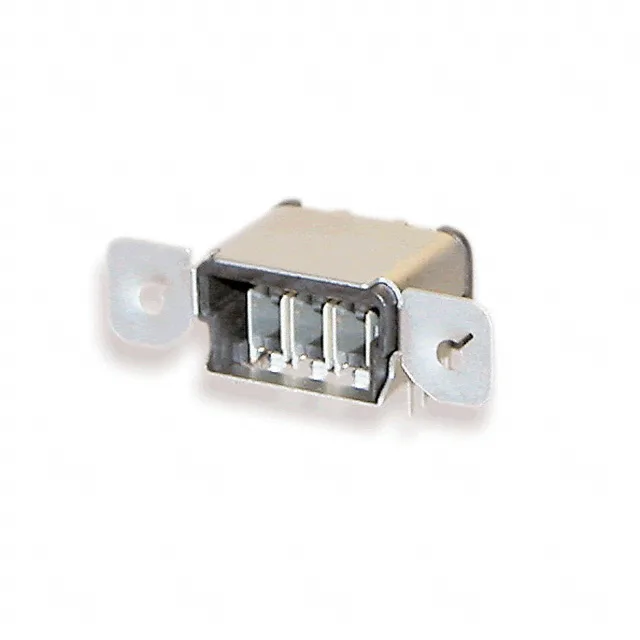
It carries a 50 Ohm characteristic impedance, rated to 6 GHz with a 0.4 dB insertion loss across the band. The mounting flange secures the body to the board; the push-pull fastening gives a positive engagement without a threaded coupling nut. The centre contact is tin-plated copper alloy — the tin finish is the limiting factor for mating cycle life, rated at 500 cycles. The steel body carries a tin finish; the dielectric is liquid crystal polymer (LCP).
This receptacle uses a hybrid mounting footprint: surface-mount pads for the signal contacts combined with through-hole posts for the shield and mechanical retention. The mounting flange adds shear-load resistance during cable handling. The centre contact termination is also solder, so the assembly requires a soldering step for both signal and ground paths.
Cable compatibility and field use
The 1274824-2 is specified for RG-174 and RG-316 coax cables. Both are 50 Ohm cables with similar outer diameters — RG-174 is the standard flexible type, RG-316 uses a PTFE dielectric for higher temperature tolerance. The solder termination works with either; the choice depends on the temperature and flex requirements of the installation. With 500 mating cycles, this connector is suitable for test points, calibration ports, or modular board assemblies that see periodic reconnection.
RoHS compliance is standard for TE Connectivity's current RF connector line, so it meets the material restrictions for EU and most global markets.