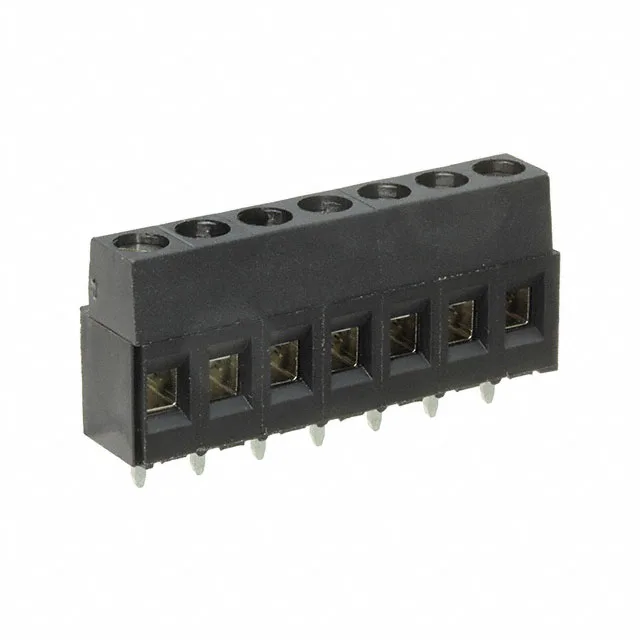
It uses a screw-actuated rising cage clamp to terminate solid or stranded wire from 12 AWG to 30 AWG — the clamp lifts a nickel-plated brass plate against the wire, not the screw tip, so the conductor is captured without damage. The 5.00 mm pitch and 300 V / 17.5 A rating place it squarely in industrial control panel wiring: PLC I/O, power distribution blocks, and motor starter terminal strips where the board sits inside an enclosure and the wires enter horizontally from the side.
The 5.00 mm pitch sets the footprint: each position occupies 5.00 mm of board edge, so the 7-position block spans 35.00 mm plus the end-wall thickness. The 300 V voltage rating covers 277/480 VAC line-to-neutral distribution inside a panel. The M3 screw torque spec of 0.79 Nm (7.0 Lb-In) is the clamp force that ensures the rising cage grips the wire without cold flow or pull-out — field techs should use a torque driver, not guess.
Termination and Installation
Wire termination is a screw-actuated rising cage clamp. Strip the wire to the length specified in the product drawing, insert it into the clamp opening, and tighten the M3 screw to 0.79 Nm (7.0 Lb-In). The rising cage lifts the nickel-plated brass clamp plate against the conductor — this gives a gas-tight connection that resists thermal cycling. The clamp material is brass with nickel plating; the screw is brass with nickel plating; the contact surface is brass with tin plating. The housing is polyamide (PA66) — standard for terminal blocks in dry indoor environments. The side interlocking feature lets you snap multiple blocks together side-by-side to build a wider multi-position assembly without a separate jumper bar, though the 7-position block is a single molded piece.