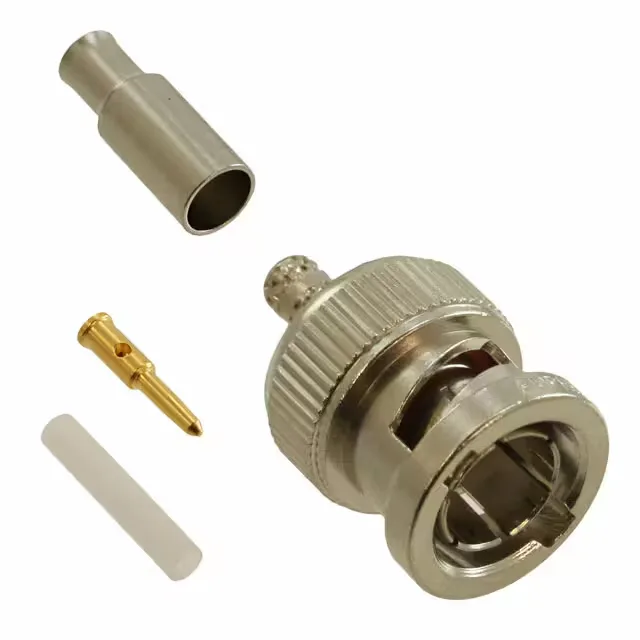
75 Ohm BNC for RG-179 — the video/broadcast variant
The 031-71013-RFX: The 3 GHz max frequency ceiling covers HD-SDI, baseband video, and surveillance camera runs, but stops short of satellite IF or microwave bands where a 50 Ohm BNC or N-type would be needed. The kit ships as 4 pieces: the connector body, a gold-plated brass centre contact, a crimp ferrule for the braid, and a sleeve that insulates the cable jacket entry. That hybrid termination — crimp the shield, solder the pin — is standard for field-installed BNCs where the braid needs a gas-tight mechanical grip but the centre conductor gets a soldered joint for lowest insertion loss (0.2 dB).
Why 75 Ohm matters — and where this sits against the 50 Ohm siblings
The 31-315-RFX and 31-320-RFX are the 50 Ohm siblings in the same Amphenol RF BNC family — same bayonet lock, same 500 mating cycles, same 0.2 dB insertion loss, same nickel-plated brass body. The difference that drives the selection: impedance and cable group. The 031-71013-RFX is 75 Ohm and mates with RG-179-class cables (thin, 75 Ohm video coax). The 31-315-RFX is 50 Ohm and mates with RG-174/RG-316 (thinner, 50 Ohm data coax). The 31-320-RFX is also 50 Ohm but steps up to RG-58 (thicker, higher power handling). A 75 Ohm plug on a 50 Ohm cable creates a 1.5:1 VSWR mismatch — don't cross them. The 031-70016 is the 75 Ohm bulkhead jack (female) that mates with this plug for a panel-feedthrough video path.
Field termination checklist — crimp the braid, solder the pin
Termination sequence for this kit: (1) slide the sleeve and ferrule onto the cable in order, (2) strip the cable jacket and braid to the dimensions in the Amphenol RF installation drawing for RG-179, (3) solder the centre contact onto the centre conductor — the gold plating wets well with a 60/40 or lead-free solder, (4) push the contact into the dielectric until it seats, (5) slide the ferrule over the braid and crimp with the correct hex die for RG-179 ferrule diameter.