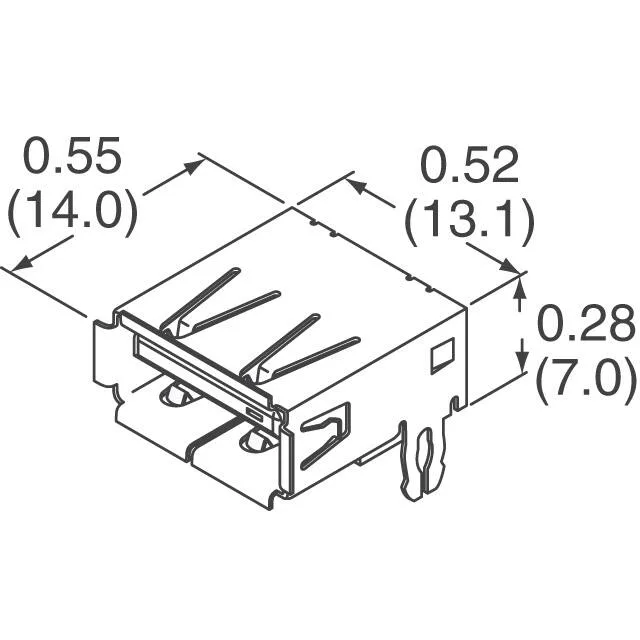
USB 2.0 Type-A Receptacle with Board Lock
It carries 4 contacts in a single port, terminated through-hole and mounted right-angle to the board — the standard orientation for a rear-panel or board-edge USB port. The white insulation color is typical for unshielded USB receptacles in this series. The gold and GXT™ contact finish supports 1500 mating cycles, which is above the USB-IF minimum of 1500 for standard-duty USB-A receptacles. The GXT plating is a palladium-nickel alloy with a gold flash — it resists fretting corrosion better than straight gold in high-vibration or repeated-mate applications. Board lock features on the solder tabs anchor the connector against the insertion and withdrawal forces of a USB plug — without them, the right-angle solder joints would fatigue over repeated cycles.
Unshielded — Plan the EMI Path
This receptacle is unshielded — the shell is copper alloy but there is no grounding shield or ferrite built into the connector body. In a USB 2.0 application running at 480 Mbps, the unshielded path means the system relies on the cable's own braid and the PCB ground plane for EMI containment. For a metal enclosure, the panel cutout should contact the receptacle's shell tabs to bleed common-mode noise; in a plastic enclosure, expect higher radiated emissions unless external filtering is added.
1500 Mating Cycles — Field Replacement Duty
The 1500-cycle rating is the mechanical endurance of the contact beams — after that, the normal force drops and contact resistance starts to rise. For a consumer device that sees one mate per day, that is about four years of service. For a field-serviceable industrial panel where a technician plugs and unplugs a laptop several times a week, the 1500-cycle rating is adequate but not generous. If the application demands higher durability, the 87520-1010BLF sibling carries 5000 cycles at the same 3 A rating and contact finish.