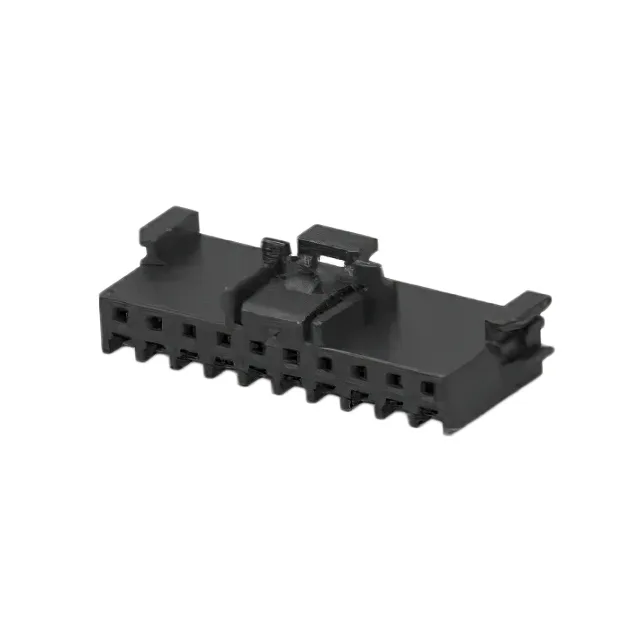
It uses a 2.00mm pitch and a single-row layout, so it fits harnesses that need a compact, in-line connector — think automotive interior modules, industrial sensors, or appliance control boards where the wiring runs free-hanging rather than panel-mounted. Crimp termination means you can build the harness on a bench with a standard tool and re-pin it on site if a terminal backs out.
Matching the Mating Half and the Harness
For a 10-circuit, single-row, 2.00mm-pitch harness, the receptacle half is the matching TE part with the same circuit count. On the wire side, the housing accepts the crimp socket contacts; the wire range and strip length follow the terminal datasheet.
Latch Holder Retention — Field-Service Reality
The latch holder is the retention mechanism that keeps the plug mated to the receptacle under vibration. Unlike a friction-only fit, the latch clicks in and needs a deliberate squeeze on the release tab to disengage. That matters on a factory floor or in a vehicle harness: a connector that backs out mid-shift stops the line. If you are servicing a machine and find a loose connector, the latch is what you check first — if the tab is broken, the housing needs replacement. Because this is a crimp housing, you can swap it without de-pinning the whole harness: extract the terminals from the old housing, insert them into the new one, and re-latch. The glass-filled PA66 housing does not creep under clamp load, so the latch stays positive over temperature cycles.