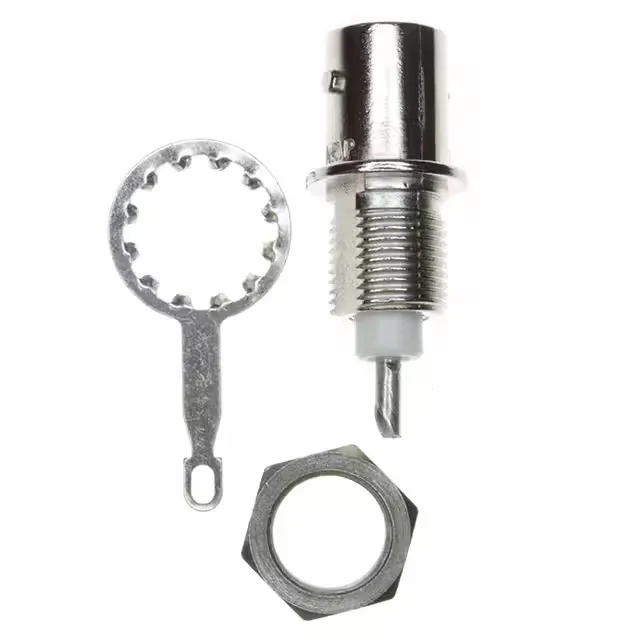
It ships as a three-piece kit: the connector body, a coupling nut, and a solder tag for shield termination.
The 50 Ohm impedance matches 50 Ohm cable without an impedance step that would cause return loss. The 4 GHz maximum frequency is the practical ceiling for the BNC interface. The solder cup contact termination accepts a centre conductor up to about 1.0 mm diameter — typical for RG-58 or RG-223 centre pins. The solder tag shield termination requires the braid or drain wire to be soldered directly to the tag, which gives a solid ground connection but demands a clean soldering station. For field installations where a crimp tool is preferred, a BNC with crimp ferrule termination would be a faster alternative.
Mechanical and environmental
The tin centre contact plating will show wear sooner than gold in a high-cycle test fixture — if the connector will be mated daily, consider a gold-plated BNC variant. The PBT dielectric maintains its dielectric constant across that range, keeping the 50 Ohm impedance stable. The bayonet lock coupling provides a quick quarter-turn mate with positive retention — the locking ramp engages with a distinct click. The bulkhead mounting feature uses a rear-side nut that tightens against the panel, securing the connector in a cut-out. The extended insulation feature (noted in the spec) adds extra dielectric standoff between the centre contact and the body, useful for the 500 V rating in higher-voltage RF paths.